Planning
Packing, and why everyone takes too much
The rules that experienced travellers converge on are consistent, and the reason people ignore them is identifiable.
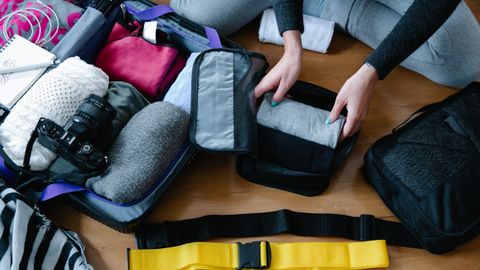
Almost everyone takes more than they use, and the pattern is consistent enough to explain.
Why it happens
Packing is done at home, where every item is visible and each seems potentially useful.
The cost of taking something is invisible at that moment; the cost of not having it is vividly imaginable.
Which produces a systematic bias toward inclusion, and it is not corrected by experience unless the traveller notices what they did not use.
The rules that work
Lay everything out, then remove half. The most cited advice and genuinely effective.
Pack for a week regardless of trip length. Laundry is available everywhere, and washing a few items in a sink takes minutes.
The difference between a week's clothing and a month's is entirely about whether you are willing to do laundry.
Everything should work with everything. A limited palette means every combination works, which reduces the quantity required substantially.
One pair of shoes plus one. Shoes are the heaviest and bulkiest items, and most people take three pairs and wear two.
Take fewer things you might need and more things you will definitely use.
The carry-on question
Travelling with hand luggage only has substantial advantages: no waiting, no loss, no fees on many airlines, and complete mobility on arrival.
It is feasible for most trips of any length, with the constraints being climate extremes, specialist equipment, and liquid restrictions.
The main obstacles people report are shoes, jackets and toiletries, all of which are addressable.
Worth checking the specific airline's dimensions and weight limits, which vary and which budget carriers enforce strictly.
Personal item allowances also vary, and on some airlines a second small bag is included while on others it is not.
What is genuinely worth carrying
Beyond clothing.
Any medication, in hand luggage, in original packaging.
A copy of documents, both digital and physical.
A universal adapter, checked against the destination's plug type and voltage.
A portable battery, which must be in hand luggage under aviation rules.
A reusable water bottle, empty through security.
A small first aid supply, discussed elsewhere on this site.
Something warm and something waterproof, regardless of forecast, in a form that packs small.
And a bag that folds flat, for day use and for the return journey.
What people take and do not use
Consistently reported.
Formal clothing for an occasion that does not arise.
Books, which are heavy and available digitally.
Full-size toiletries, when the destination sells the same products.
Multiple electronic devices with separate chargers.
A hairdryer, which almost all accommodation provides.
Travel-specific gadgets bought for the trip.
And a second bag intended for purchases, which encourages the purchases.
The packing method
Practical points that make a difference.
Rolling versus folding is largely a matter of preference; both work and rolling generally fits slightly more.
Packing cubes do not save space and do make finding things much easier, which for a multi-stop trip is worth more.
Heavy items go at the bottom near the wheels for balance.
Wear the bulkiest items on travel days.
Leave space, since almost everyone returns with more than they left with.
And keep the essentials — medication, documents, a change of clothes, a charger — in hand luggage regardless of whether you are checking a bag.
The luggage itself
A brief note.
Wheeled cases work well on smooth surfaces and badly on cobbles, stairs and unpaved ground.
Backpacks work everywhere and are harder on the back over long distances.
Which suits which trip depends substantially on the destination's infrastructure, and it is worth thinking about the actual route from the station to the accommodation.
Whatever is chosen, it is worth being able to carry it up a flight of stairs, since at some point you will have to.
The list worth keeping
A practice that improves every subsequent trip.
After returning, note what you did not use and what you wished you had brought.
Keep that list and consult it before packing next time.
Most people find the same items appear repeatedly in the unused column, and that acting on it reduces the load substantially within two or three trips.
It also identifies the small number of items that are genuinely essential for you specifically, which no general list captures.
Also by Sofia Marchetti
- Travel and mental healthSafety & Health
- Booking platforms and what they doWhere to Stay
- The trip you actually wantPlanning
- Women travelling aloneSafety & Health


