Flights & Transport
Trains, buses and the ground alternatives
Surface transport is frequently faster than flying once the whole journey is counted, and it changes the trip.
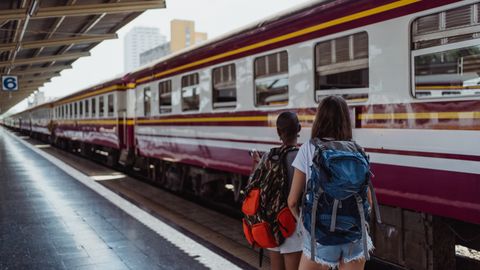
Short-haul flying looks fast on a timetable and rarely is once the whole journey is counted. Ground transport frequently wins on time as well as on experience.
The door-to-door comparison
The arithmetic people do not do.
A flight involves travel to the airport, arriving well before departure, security, boarding, the flight itself, disembarking, baggage, and travel from the destination airport to the city.
Airports are generally far from city centres; central stations generally are not.
On journeys of up to several hundred kilometres, high-speed rail is frequently faster end to end, and even conventional rail is competitive.
The commonly cited threshold is around three to four hours of rail time, below which rail generally wins on total journey time.
Rail in practice
High-speed networks in Europe, Japan, China, South Korea, Taiwan and elsewhere are genuinely fast and generally reliable.
Booking well in advance secures much lower fares on most of these, since they use advance-purchase pricing similar to airlines.
Conventional and regional rail is generally cheaper, slower and more flexible, frequently with fares that do not vary by booking date.
Night trains, which have expanded in Europe after a period of decline.
These convert a travel day into a night and save a night's accommodation, which changes the economics considerably.
Sleeping quality varies with the accommodation booked — a couchette shared with several strangers is a different proposition from a private compartment.
Rail passes
Frequently assumed to be good value and frequently not.
The calculation depends on how many journeys, how long, and whether the routes require reservations with supplements.
Passes generally suit travellers making many journeys over a short period, taking longer routes, and valuing flexibility.
Point-to-point tickets bought in advance generally suit travellers with a fixed itinerary and fewer journeys.
The reservation supplements on high-speed and night services are the item most often overlooked, and they can substantially erode the pass's value.
Doing the arithmetic against actual planned journeys takes twenty minutes and frequently changes the decision.
Long-distance buses
Generally the cheapest option and the slowest.
Networks have consolidated in Europe and North America, with a small number of operators covering most routes.
Quality varies enormously by country. In parts of South America and Asia, long-distance buses are comfortable and well organised; elsewhere they are basic.
Overnight buses save accommodation and generally produce poor sleep, and the calculation of whether that is worth it depends on the following day's plans.
Ferries
Under-used and frequently the most pleasant option.
Substantial networks operate in the Mediterranean, the Baltic, the Aegean, around Japan and Indonesia, and along several coastlines.
Overnight ferries with cabins combine transport and accommodation, and deck passage is very cheap where permitted.
Worth checking seasonal schedules, since many routes reduce or stop outside the summer.
Driving
Which suits some trips and not others.
It works well for rural areas, national parks and regions with dispersed sights, and badly for cities, where parking and restricted zones make it a liability.
Points to check: whether an international driving permit is required, what the insurance covers, whether cross-border travel is permitted, and what road tolls and vignettes apply.
Several European cities have low-emission zones with automatic enforcement, and fines reach visitors months later through the rental company.
The case for going slowly
Beyond logistics.
Ground transport passes through the landscape between destinations, which is where a great deal of a country actually is.
It also produces incidental encounters — station towns, fellow passengers, unplanned stops — that flying eliminates entirely.
And for anyone weighing environmental impact, the difference between rail and short-haul flying per passenger kilometre is substantial, by a factor that varies with the electricity source and remains large.
Booking and reservations
The practical differences worth knowing.
High-speed and long-distance services generally require a seat reservation, which may be included in the fare or charged separately.
Regional and local services generally do not, which means a ticket can be bought and used on any service that day.
Several national operators sell only through their own systems, and third-party sites add a booking fee for the same ticket.
Finding the national operator's own site is worth the few minutes it takes.
Also by Sofia Marchetti
- Travel and mental healthSafety & Health
- Booking platforms and what they doWhere to Stay
- The trip you actually wantPlanning
- Women travelling aloneSafety & Health